From Keawakapu at the Kīhei end of Wailea to Big Beach at Mākena, the only lifeguards are at Mākena State Park, which is also where the state charges nonresidents to enter and to park. Wailea’s beaches are public, reached through the County of Maui’s shoreline accesses, each with its own lot or street parking, and none has a lifeguard. Mākena State Park, about 4 miles’ drive south of Wailea, is the state’s: its Oneloa (Big Beach) and Oneuli (Black Sand) are open from 5:00 a.m. to 7:00 p.m. HST, to 7:45 p.m. in May, June and July, and nonresidents pay $5 a person and $10 to park. Nobody needs a reservation.
The state posts one warning above all others there: the shore break can be very dangerous. The state’s list and the County give Big Beach’s lifeguards different hours (below), and both have one on duty from 8 a.m. to 4:45 p.m. HST: swim within those hours.
Mākena State Park: Big Beach, Oneuli and Little Beach
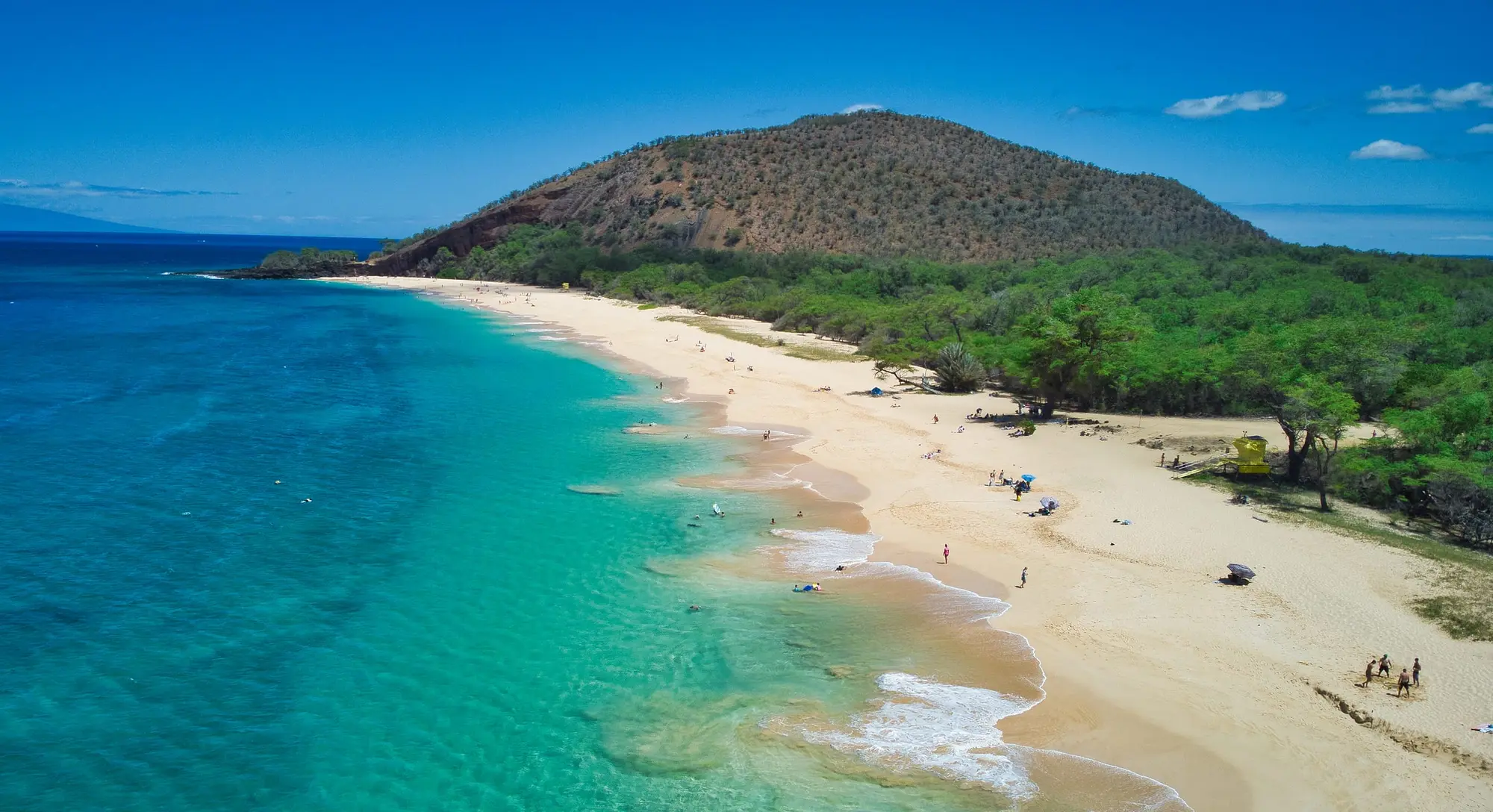
Mākena State Park is 164.4 acres of wild beach park at the south end of the resort coast, marked by the cinder cone Puʻu Ōlaʻi and a large white sand beach. It is for swimming in calm seas, bodysurfing, board surfing and shore fishing. The Division of State Parks sets the hours for three beaches in it, as of 20 November 2026:
| Beach | Hours (HST) |
|---|---|
| Oneloa (Big Beach) and Oneuli (Black Sand) | Daily, 5:00 a.m. to 7:00 p.m.; in May, June and July, 5:00 a.m. to 7:45 p.m. |
| Puʻu Ōlaʻi (Little Beach) | Saturday and Sunday, 5:00 a.m. to 4:00 p.m.; weekdays, 5:00 a.m. to 7:00 p.m. |
There is no drinking water anywhere in the park, so bring what you will drink. The County’s survey of public accesses counted two paved lots at Big Beach, 50 stalls each, both with restrooms and neither with showers.
What Mākena costs
Hawaiʻi residents get in and park free with a Hawaiʻi driver’s license or a state ID. Everyone else pays the state:
- Entry: $5 a person; children 3 and under are free.
- Parking: $10 a vehicle.
So a car with two nonresident adults pays $20, and a nonresident family of four with both children over 3 pays $30. The park is paid parking: nonresidents pay for the car at the lot’s kiosks on arrival, or online. These are the state’s figures as we read them on 20 November 2026; Maui’s other fees and its taxes are on what a Maui trip costs.
No reservation
Mākena takes none. On Maui the state’s park reservations are for ʻĪao Valley State Monument and Waiʻānapanapa State Park, and each of those pages has its window and its fee. At Mākena nonresidents pay and go in.
The shorebreak, and the only lifeguards
Shorebreak is a wave that breaks directly onto the beach, where the bottom rises quickly from deep water to shallow, and it can knock anyone in the water off their feet and drive them into hard sand. Hawaiʻi’s Department of Health puts the average wave height when a spinal cord injury happens at 3 feet, so a small day is no promise. Its advice holds here: stay out when the shorebreak is strong, stand back from the water’s edge, never dive into a breaking wave head first but duck under it, and if one catches you, protect your head and neck with your arms.
The state’s list of lifeguarded beaches, updated 15 June 2026, gives Mākena State Park lifeguards every day from 8 a.m. to 4:45 p.m. HST. The County’s Ocean Safety Bureau gives its lifeguards longer days: since 6 April 2025, it said on 17 April 2025, they cover the beaches from 7:30 a.m. to 6:15 p.m. HST from 16 September to 15 March and from 8:00 a.m. to 6:45 p.m. from 16 March to 15 September, and to sunset when high surf or other dangerous conditions call for it. The state’s list is the newer of the two pages; both have a lifeguard on duty from 8 a.m. to 4:45 p.m., so swim within those hours. The County’s access survey recorded a tower at each of Big Beach’s two entrances, and Big Beach is the only guarded beach on this page: the County recorded no tower at any Wailea access, at Mākena Landing or at Maluaka, and none of them is on the state’s list. The state’s rule of thumb is to always swim at a lifeguarded beach; when the tower is empty, its instruction is to call 911 for lifeguard services.
The surf on this coast comes in summer. The state’s Department of Health gives south shores flat-to-small waves from November through April, and from May through October large swells that can arrive frequently, raised by winter storms in the southern hemisphere.
If a green sea turtle or a Hawaiian monk seal is resting on the sand or swimming near you, NOAA Fisheries’ guidance in Hawaiʻi is to stay at least 10 feet from a turtle and 50 feet from a seal, on land and in the water, 150 feet from a mother seal and her pup, and never to disturb an animal asleep on the beach.
Wailea’s beaches, north to south
Wailea’s beaches are reached through the County’s public shoreline accesses: beach parks, street ends and easements, most with a paved lot. The County’s access survey gives each one’s parking and facilities from its site visits in June 2018, so the stall counts below are the County’s from that survey, not a count from this season. It lists its own accesses with “Restricted Hours” but gives no times, and no parking rate. The County also notes that its access data were gathered before COVID-19 and that some accesses may be at least temporarily affected.
| Access | What it is | Parking (the County, 2018) | Restroom, shower |
|---|---|---|---|
| Keawakapu Beach III, at Mana Kai | State land | Unpaved lot | Shower only |
| Keawakapu Beach I | County beach park | Paved lot, 65 stalls, across the street | Shower only |
| Keawakapu Beach II | County beach park | Paved lot, 23 stalls; street parking too | Both |
| Ulua Beach (Ke One Ulua) | County street end | Paved lot, 75 stalls | Both |
| Wailea Beach (Kahamanini) | County beach park | Paved lot, 100 stalls | Both |
| Polo Beach | County easement | Paved lot, 75 stalls | Both |
| Palauea Beach | County beach park | Street parking | Restroom only |
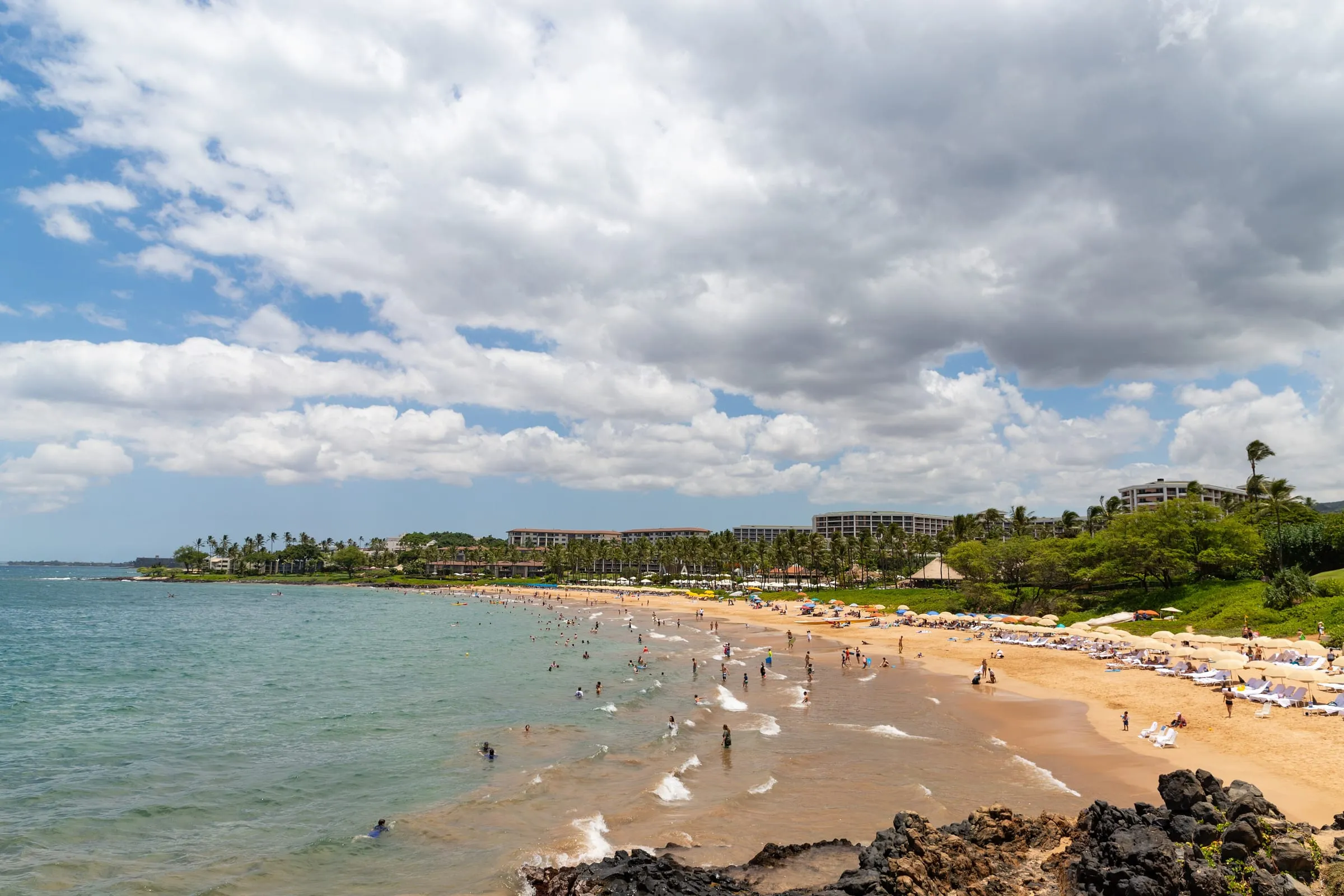
The County lists the accesses at Keawakapu Beach I, Ulua Beach and Wailea Beach (and Makena Surf I, below) as ADA accessible, and the one at Keawakapu III, on state land, as open all hours. No lifeguard works any of these beaches. The photograph below shows Wailea Beach from the lava rocks at one end, with the resorts behind the sand.
Mākena, from Polo to Big Beach
South of Polo and Palauea the coast turns to Mākena. The County lists these public accesses, north to south, before and in the state park:
| Access | What it is | Parking (the County, 2018) | Restroom, shower |
|---|---|---|---|
| Poʻolenalena Park (“Chang’s Beach”) | State park, sand | Unpaved lot | Restroom only |
| Makena Surf I | Easement across private land, sand | Paved lot, 9 stalls | Shower only |
| 5 Caves 5 Graves | Easement across private land, rocky lava shore | Street parking | Neither |
| Mākena Landing | Park, private land open to the public, rocky lava shore | Paved lot, 30 stalls | Both |
| Mākena Bay | Open access across private land, sand | Street parking | Neither |
| Maluaka Beach | Street end, sand | Paved lot, 10 stalls; a second lot of 50 stalls behind a locked gate in 2018 | Both |
| Mooiki (“Black Sand”) | State park, sand | Unpaved lot | Neither |
| Big Beach I and II (Oneloa) | State park, sand | Paved lots, 50 stalls each | Restroom only |
Two of these are where trips meet the water. The guided Turtle Town snorkels and kayaks we compare on Maui snorkel tours meet at Mākena Landing, and Kai Kanani’s boats load from the sand at Maluaka Beach, after check-in at its store in Wailea and a ride in its vans, for its trips on Molokini snorkel tours and Maui sunset and dinner cruises.
Getting there
By car, without traffic:
| From | To | Miles | Drive, about |
|---|---|---|---|
| Kahului Airport | Wailea | 15.8 | 33 minutes |
| Kīhei (Kalama Park) | Wailea | 3.6 | 10 minutes |
| Wailea | Mākena Landing | 2.6 | 7 minutes |
| Wailea | Maluaka Beach | 3.1 | 9 minutes |
| Wailea | Big Beach lot, Mākena State Park | 4.3 | 12 minutes |
| Kīhei (Kalama Park) | Big Beach lot | 7.9 | 21 minutes |
| Kāʻanapali (Whalers Village) | Big Beach lot | 35.6 | 1 hour 14 minutes |
From Wailea, Big Beach is down Wailea Alanui Drive, Mākena Road and Mākena Alanui. From Kāʻanapali it is about an hour and a quarter’s drive; West Maui’s own beach is on Kāʻanapali Beach, and the case for sleeping in Wailea or Kīhei instead is on where to stay on Maui.
When to go
Winter is the calmer season on this coast, by the state’s surf seasons above, and South Maui is dry all year: NOAA’s 1991–2020 normals for the rain gauge north of Kīhei run from 2.31 inches in January to 0.02 inches in June. The rest of the year, month by month, is on the best time to visit Maui, and the humpback season, with the rule on how close you may go, is on Maui whale season 2026–27.
Out on the water
The beaches on this page are for the sand and a swim in calm seas. Turtle Town from the shore or by kayak, and a first snorkel in Wailea, are compared on Maui snorkel tours, and the Molokini boats, Kai Kanani’s from Maluaka among them, on Molokini snorkel tours. If neither fits your days, the Maui listing at the end of this page is everything bookable on the island; check where each trip starts, since they leave from all around Maui.