
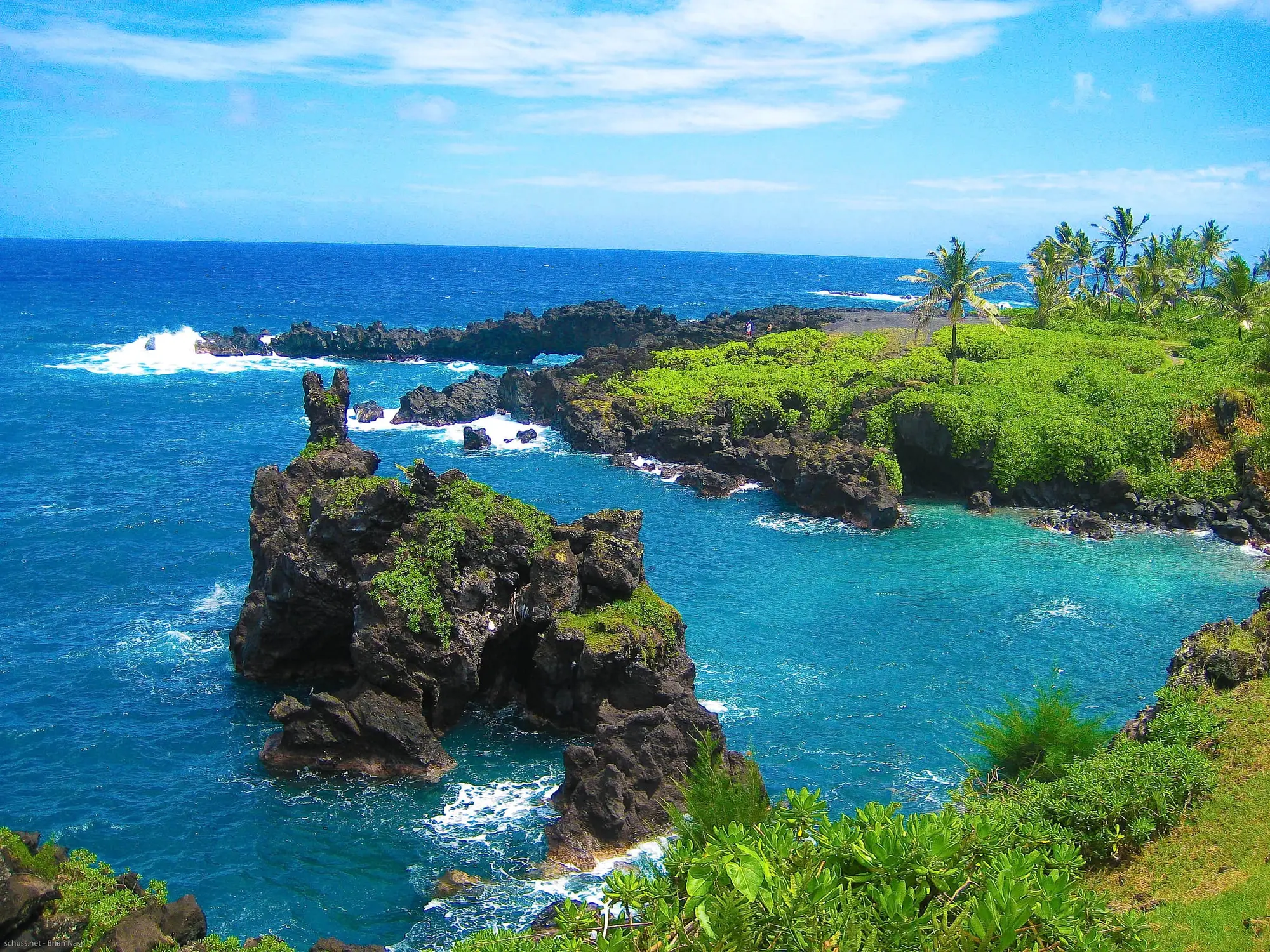

Waiʻānapanapa State Park is the one stop on the Road to Hāna you cannot just pull into. Unless you live in Hawaiʻi, you need a reservation for a time slot, bought at least a day ahead and no more than 30 days ahead: $10 to park the car and $5 a person to enter, plus the reservation’s service charges. The park is open 7:00 a.m. to 6:00 p.m. HST every day. In a notice dated 5 November 2026 the Division of State Parks said the eastern parking lot and campervan camping were closed for facility improvements, with beach access through the western entrance.
Waiʻānapanapa means “glistening waters”, and it is a stretch of wild volcanic coast 3.4 miles short of Hāna town: black lava, sea stacks and blowholes, a natural stone arch, a seabird colony, native hala forest, a heiau (a Hawaiian temple site), and Pailoa, its small black sand beach. Every clock time on this page is Hawaii Standard Time (HST), which does not change for daylight saving.
The reservation
Who needs one. Every visitor who is not a Hawaiʻi resident. Residents enter and park free with a Hawaiʻi driver’s license or ID, need no reservation, and show proof of residency at the gate. A resident’s out-of-state guests are not exempt: the resident buys “entry only” tickets for them in advance, and never pays to park.
What you buy. Arriving in your own car, you buy parking and entry: one parking voucher for the vehicle and an entry for every person in it, driver included. The parking voucher on its own admits nobody. Four nonresidents in one car pay $30, plus the reservation’s service charges, and children 3 and under enter free. Entry only is the other ticket. The reservation site sells it “only for guests accompanied by a Hawaiʻi resident”; the Division’s own FAQ says that anyone who walks or cycles in, or is dropped off by a taxi or rideshare, needs entry tickets only. The FAQ’s answer is dated by its own first line, “As of April 19, 2021”; the reservation site’s line carries no date. The ticket both accept is parking and entry, which the reservation site asks every nonresident to buy.
When. Dates open 30 days ahead, released one day at a time at midnight HST, and sales close the day before: nothing is sold on the day, and nothing at the park. The park gets busy at certain times of day and its slots can sell out, so reserve the day your date opens. The reservations are the state’s own, sold only on its reservation site, gostateparks.hawaii.gov.
The slot. The day is sold in four time slots. The Division gives 7:00 to 10:00 a.m. and 10:00 a.m. to 12:30 p.m. as two of them; the last parking slot runs from 3:00 to 6:00 p.m., and you must be in by 5:30 p.m. You leave when your slot ends, so a longer visit means buying the next slot too, if it is still available.
Be there in the first 30 minutes. The reservation site says to arrive within the first 30 minutes of your slot, and that after that you may be denied entry or parking, with no refund for a late arrival or a no-show. Its own FAQ, and the Division’s, say you can enter at any time within the slot. Go by the stricter rule, and book the slot for the hour you will really arrive, with your stops along the highway counted.
Changes and refunds: the state’s own pages disagree. The reservation site’s terms, on its FAQ and its About page (neither dated), allow a refund up to 3 days before your date, and a change up to midnight Hawaiʻi time on the day before if the new date and time have space; a $5 cancellation fee and service fees may apply. The Division’s own FAQ, in an undated answer, says a reservation’s date and time cannot be changed once bought: “ALL SALES ARE FINAL. No refunds, no exceptions.” So book only a date you are sure of. Neither refunds a late arrival or a no-show. Rain earns no refund either: the reservation site refunds for weather only when the state officially closes the park for hazardous conditions or an emergency, and the Division’s park notices of 12 November 2026 say a reservation for a day of a storm closure is refunded automatically, minus the service charges, which it keeps.
The timed reservations work: the Division’s count in its release of 3 June 2026 put visits at more than 2,000 a day before them and 1,200 to 1,500 a day after. The same release said the area is still hit by heavy visitor traffic.
Fees and hours
| Nonresidents | Hawaiʻi residents | |
|---|---|---|
| Entry | $5 a person; children 3 and under free | Free with a Hawaiʻi driver’s license or ID |
| Parking | $10 a vehicle | Free with a Hawaiʻi ID or driver’s license |
| Reservation | Required, up to 30 days ahead, never on the day | None, with proof of residency |
| Hours | 7:00 a.m. to 6:00 p.m. HST daily | 7:00 a.m. to 6:00 p.m. HST daily |
These are the fees the Division of State Parks charged on 20 November 2026, plus the reservation system’s service charges, which the state keeps even when a storm closes the park (its park notices of 12 November 2026). What they add to a whole trip, with the room and car taxes, is on our what a Maui trip costs page, and the other two reservations a Maui driver may need, at Haleakalā and ʻĪao, are on getting around Maui.
The eastern lot and the facility project
In a notice dated 5 November 2026, under its park notices of 12 November 2026, the Division of State Parks said the park’s eastern parking and campervan camping were closed for facility improvements. The campervan lot is open to day visitors and tent campers, tour bus parking has moved along the access road, and beach access is via the western entrance. The Division gives no date for the lot to reopen.
The closure belongs to a project the Division announced in its release of 3 June 2026, which set the construction phase to begin on Monday 6 July 2026: a new comfort station beside the eastern lot, then expected to be finished in the fall, and Honokalani Road resurfaced, with completion scheduled for early 2027. The release said the eastern day-use and tour bus lot would be closed for the length of the project, and that the road work may close the park temporarily, with access kept for the residents of Honokalani Road. When we checked on 20 November 2026, the notice still stood and the reservation site said the project was underway.
Pailoa, the black sand beach
Pailoa is the park’s small black sand beach, on Pailoa Bay, and while the project lasts the way to it runs through the western end of the park.
The Division lists swimming among the park’s activities, and dangerous shorebreak, strong current and waves breaking on the ledge among its hazards. No lifeguard watches it: the state’s list of lifeguarded beaches, updated 15 June 2026, does not include Waiʻānapanapa, and nor does the County’s own list of its towers when we read it on 20 November 2026. The nearest tower on this coast is at Hāna Bay: daily on the state’s list, but on the County’s only “Fridays during Summer and Winter Pals Program days”. With any surf running, stay on the sand.
The coast and the old trail
Beyond the beach, the park is volcanic coast best seen on foot. Its coastal path is part of an ancient Hawaiian trail that leads on toward Hāna, which the Division names “Ke Ala Loa O Maui/Piilani Trail”. The trail has no drinking water, falling rocks are its listed hazard, and bicycles, fires, camping and smoking are not allowed on it.
In the park itself the Division lists restrooms, showers, a water fountain, picnic tables, a walking path and a scenic viewpoint, and marks the park ADA accessible. Alcohol and smoking are not allowed anywhere in the park.
Getting there
The park sits off the Hāna Highway by Honokalani Road, 3.4 miles short of Hāna town, about 10 minutes away. From Pāʻia it is about 42 miles, 1 hour 35 minutes with no stops and no traffic, so allow far longer with the stops along the way. The drive from Kahului, Kīhei, Wailea and Kāʻanapali, and the stops along the way in order, are on our Road to Hāna page; past Hāna, the Kīpahulu District is on our Haleakalā National Park page.
Without a parking voucher there is nowhere to park: the Division says the road leading up to the park is privately owned and cars parked on it are towed. A night in Hāna puts the park about 10 minutes away for an early slot; our where to stay on Maui page covers Hāna as a base.
Camping and the cabins
The park has tent campsites and cabins, by permit only. A campsite is $30 a night for nonresidents and $20 for residents; a cabin is $100 a night for nonresidents and $70 for residents, and must be reserved at least 7 days before check-in. Camping can be reserved 90 days ahead, and stays from 1 February 2026 on are reserved on the state’s Explore Outdoor Hawaiʻi system (the Division’s update of 12 December 2025). In its notice dated 5 November 2026 the Division said campervan camping was closed for the facility project, and the campervan lot is open to tent campers and day visitors. Its notice of 1 July 2026 said campervan camping reservations were unavailable through March 2027, during the construction of the park’s new comfort station.
On a tour instead
Most of the shared tours on our Road to Hāna tours page include Waiʻānapanapa’s admission in their price, so the slot is the tour’s to arrange and nobody in your party drives the highway. Tour buses park along the access road while the eastern lot is closed. For anything else on Maui, Viator’s whole Maui catalog is linked below.


