Haleakalā National Park runs from the 10,023-foot summit of Haleakalā down the mountain’s southeast flank to the Kīpahulu District on the coast near Hāna. Its two halves are not directly connected by road. The summit is a drive up the volcano, and Kīpahulu is 12 miles past Hāna on the Hāna Highway. Both are reached from Kahului, and no public transport goes to either.
One entrance fee covers both districts for three days. Below are the fees and passes, the hours and the sunrise rule, the drive up, the four summit overlooks and their elevations, the trails, Kīpahulu and the Pools of ʻOheʻo, camping, and what the Park Service’s alerts said, as each stood on 20 November 2026.
Two districts, two separate drives
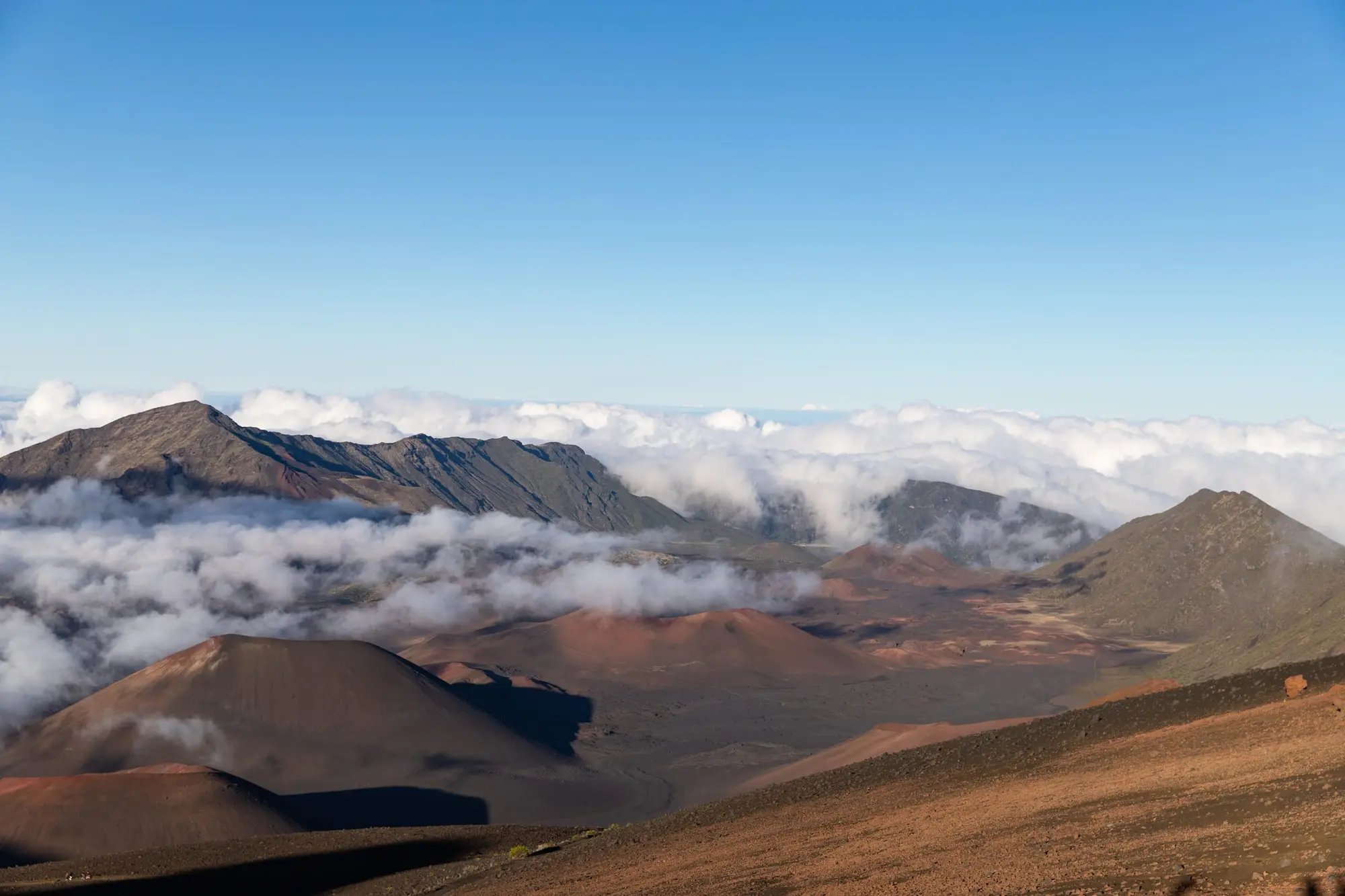
The Summit District is the top of the volcano: the crater and its cinder desert, the overlooks along the summit road, the Haleakalā Visitor Center at 9,740 feet and, lower down, the Park Headquarters Visitor Center. The Kīpahulu District is the coast below it: streams, waterfalls, a bamboo forest, the Pools of ʻOheʻo and a coast that, in the Park Service’s words, “has been inhabited by native people for hundreds of years and remains an integral part of a thriving culture.”
The summit is reached from Kahului by Route 37 to 377 to 378, and Kīpahulu by Route 36 to 360 to 31, along the Hāna Highway. The Park Service allows 2.5 hours from Kahului to the summit and about 4 hours from Kahului to Kīpahulu, so take them on separate days: the summit for a sunrise or a sunset, and Kīpahulu as the far end of a day on the Road to Hāna. The $30 vehicle pass is good for three days, so a receipt from one district gets you into the other within that time. Keep it.
For a GPS, the Park Service gives “30,000 Haleakalā Hwy, Kula, HI 96790” for the summit district and “Mile Marker 41 Hana Hwy, Hana, HI 96713” for Kīpahulu.
Entrance fees and passes
Haleakalā does not accept cash. Pay by credit or debit card at either entrance station, or, when the station is closed, at the self-pay machine beside it, which takes credit cards only. A valid three-day receipt from either district, a valid Hawaiʻi Tri-Park pass or a current America the Beautiful pass lets you drive on past the machine. These are the Park Service’s fees as its fees page gave them on 20 November 2026 (last updated 18 December 2025):
| Pass | Price | What it covers |
|---|---|---|
| Private vehicle | $30 | Three days in both districts, for a private, non-commercial vehicle with a capacity of 14 or less and everyone in it |
| Motorcycle | $25 | Three days in both districts, for up to 2 private motorcycles carrying up to 4 people in all |
| Per person, on foot or by bicycle | $15 | One person 16 or older with no car, both districts; 15 and under free |
| Haleakalā annual pass | $55 | 12 months at Haleakalā, Hawaiʻi Volcanoes and Puʻuhonua ʻO Hōnaunau; US citizens and residents, on its card (the page’s text says otherwise, below) |
| Hawaiʻi Tri-Park Annual Pass | $55 | 12 months from the month you buy it, at the same three parks; US citizens and residents, on its card (the same) |
| America the Beautiful Resident Annual Pass | $80 | A year of entrance fees at national parks and other federal lands; US citizens and residents |
| America the Beautiful Non-Resident Annual Pass | $250 | The same, for non-US residents |
| Sunrise reservation | $1.00 | Per vehicle, to enter the summit district from 3:00 to 7:00 a.m. HST; on top of the entrance fee |
The America the Beautiful program also sells US citizens and residents aged 62 and over a $20 annual or an $80 lifetime pass, and gives free passes to current US military and their dependents, to Gold Star families and veterans, to US citizens and residents with a permanent disability and to US fourth graders.
The fees page disagrees with itself on who may buy the two $55 passes. The card for each says “Available To: US citizens and residents”, while the page’s text says “Annual passes are available to the general public including international visitors” (both as we read them on 20 November 2026, the page last updated 18 December 2025). Until the Park Service settles it, a visitor from outside the United States can count only on the $30 vehicle pass for a single visit, or the $250 non-resident annual pass, which is worth it only if your year takes in other parks with entrance fees. The Park Service’s fee-free days are for US citizens and residents too, and they never cover the sunrise reservation or entry between 3:00 and 7:00 a.m. Our Maui trip costs page adds the park fees to the room and rental-car taxes.
Hours, sunrise and sunset
Both districts are open 24 hours a day (the Park Service’s hours page, last updated 7 May 2026). The exception is the summit district before dawn: from 3:00 to 7:00 a.m. HST it admits only vehicles with a sunrise reservation, $1.00 a vehicle on top of the entrance fee. No reservation is issued at the entrance station, and a car without one is turned around until 7:00 a.m. Reservations are released 60 days ahead at 7:00 a.m. HST, with a second batch two days ahead, and 150 vehicles get in for sunrise. How to get one, and what to do when they are gone, is in our sunrise reservations guide. Riding up with a tour is the other way to see it, and our sunrise tours page compares them and says which include park entry.
Sunset takes no reservation, which makes the late afternoon the summit’s other crowd. On 20 November 2026 the Park Service’s alert (last changed 9 January 2026) read in full: “Due to a high volume of traffic, cars may be temporarily turned around at the gate when capacity is reached. Purchasing a pass online does not guarantee entry at sunset. To ensure timely access, arrive 3 hours before sunset.”
The Park Service picks no best viewpoint: all four summit overlooks, below, “have great views of sunrise over the crater, weather permitting”, and for a quieter one it points to Leleiwi or Kalahaku. Each lot closes when it is full, and no lot is promised to anyone. The weather just before dawn and just after dusk is “regularly wet, windy, and below freezing”, and a sunrise lost to cloud is neither refunded nor exchanged.
The drive to the summit
From the entrance station to the summit the road is 10 miles long and takes about 30 minutes, with no streetlights or guard rails. The Park Service’s driving times to the summit, on its directions page (last updated 27 July 2022), are the ones to plan by, above all for a sunrise start in the dark. Beside them are our times with no traffic and no stops, to the Haleakalā Visitor Center, from OpenStreetMap routing read on 19 November 2026:
| From | The Park Service | With no stops |
|---|---|---|
| Kahului | 2.5 hours | about 1 hour 25 minutes |
| Kahului Airport | - | about 1 hour 25 minutes |
| Pāʻia | - | about 1 hour 20 minutes |
| Kula | - | about 1 hour |
| Kīhei | - | about 1 hour 45 minutes |
| Wailea | 3 hours | about 1 hour 50 minutes |
| Kāʻanapali | 3.5 hours, its figure for Lahaina | about 2 hours 5 minutes |
There is no gas station in the park. The last gas on the way up is in Pukalani, and the park has no charging stations for electric vehicles; the Park Service warns that “Even electric vehicles with a full charge have been unable to make it to the Summit.” Nothing else is for sale up there either: no food, no clothing, no gas. Bring water and food, though the visitor centers have drinking water.
Drive the posted speed limits. Nēnē, the endemic Hawaiian goose, are often in the parking lots and around the roads, and on 20 November 2026 a Park Service alert (from 17 August 2023) said nēnē and ʻuaʻu, the Hawaiian petrel, were nesting in the park and may land on its roads, its parking lots and the road up to it. Park only in the designated lots. Nobody may stay overnight or sleep in a vehicle anywhere in the park outside a campground.
The four summit overlooks
The Park Service names four places to watch the sunrise, highest first, and its elevations for them:
| Overlook | Elevation | Note |
|---|---|---|
| Puʻu ʻUlaʻula (Red Hill), the summit | 10,023 feet | The highest point in the park |
| Haleakalā Visitor Center | 9,740 feet | Drinking water; the Pā Kaʻoao and Keoneheʻeheʻe (Sliding Sands) trails start here |
| Kalahaku Overlook | 9,324 feet | One of the two the Park Service suggests for a quieter sunrise |
| Leleiwi Overlook | 8,840 feet | A 10-minute walk from its lot, across the park road: 0.3 mile round trip and 100 feet of climb |
Haleakalā is sacred to Native Hawaiians. If you see people practicing cultural traditions at the summit, respect their practices and do not disturb them.
Weather and altitude at the top
The summit area is cold, high and changeable in every month. The Park Service gives its temperatures as commonly 30 to 65°F, below freezing at any time with the wind chill, and asks every visitor to prepare for “harsh UV rays, wind, rain, and cold temperatures year-round”. Bring a warm layer and rain gear, long pants, a hat, sunglasses and sunscreen, even on a hot day at the beach below. Our best time to visit Maui guide has the island’s weather month by month.
At this height there is less oxygen in each breath, which makes every trail up there harder than it looks. The Park Service warns of altitude sickness (nausea, headache, dizziness and shortness of breath) and asks pregnant women and people with heart or respiratory conditions to consult their doctor before visiting and hiking in the summit area.
Summit trails
The summit district has over 30 miles of trails, from a 10-minute walk to a crossing of the crater over several days. Hikers must stay on the marked trails, groups are limited to 12, and no pets go on any trail. On a trail that starts downhill, as Keoneheʻeheʻe does into the crater, allow twice as long to climb back out as you took to go down. The Park Service’s figures:
| Trail | Where it starts | Distance | Elevation change |
|---|---|---|---|
| Pā Kaʻoao | Beside the Haleakalā Visitor Center | 0.4 mile round trip | 100 feet |
| Keoneheʻeheʻe (Sliding Sands), to the first overlook | Haleakalā Visitor Center lot | 0.5 mile round trip | 50 feet |
| Keoneheʻeheʻe, to the crater floor | Haleakalā Visitor Center lot | 3.9 miles one way, all downhill | almost 2,500 feet |
| Keoneheʻeheʻe to Halemauʻu, across the crater | Haleakalā Visitor Center lot | 11 miles one way, a full day | ends at the Halemauʻu trailhead, 7,990 feet |
| Halemauʻu, to the first crater viewpoint | Halemauʻu trailhead | 2.2 miles round trip | 400 feet |
| Supply Trail, to the Halemauʻu junction | - | 4.6 miles round trip | 975 feet |
| Leleiwi Overlook | Across the park road from its lot | 0.3 mile round trip | 100 feet |
| Hosmer Grove | Hosmer Grove Campground | 0.54 mile loop | 50 feet |
The 11-mile crossing ends at a different trailhead from the one it starts at, and the park runs no hiker shuttle. Its own advice is to leave the car at Halemauʻu and get a ride up to the Keoneheʻeheʻe trailhead at the start, so the car is waiting at the end; fewer cars come up in bad weather to give that ride. Past the first viewpoint on Halemauʻu, a natural land bridge called “Rainbow Bridge” is about a quarter mile on, and the crater floor is a little over 2 miles from the trailhead, down switchbacks cut into the crater wall.
Kīpahulu and the Pools of ʻOheʻo
Kīpahulu is the park’s coastal district, 12 miles past Hāna on the Hāna Highway. The Park Service puts the drive at about 4 hours from Kahului; with no stops it is about 2 hours 25 minutes from Kahului and about 35 minutes from Hāna. The drive, its stops in order and the back road around the south side are on our Road to Hāna page, and the tours that drive it for you on our Road to Hāna tours page.
The summit’s entrance pass covers Kīpahulu too: $30 a vehicle for three days, by card at the Kīpahulu entrance station or its self-pay machine. The Park Service names Pāʻia as the last gas along the Hāna Highway before Hāna, and the district sells neither gas nor food. Bring water, sunscreen, mosquito repellent and sturdy shoes, and dress for hot, humid, rainy weather. Kīpahulu is remote: emergency medical help is at least an hour away.
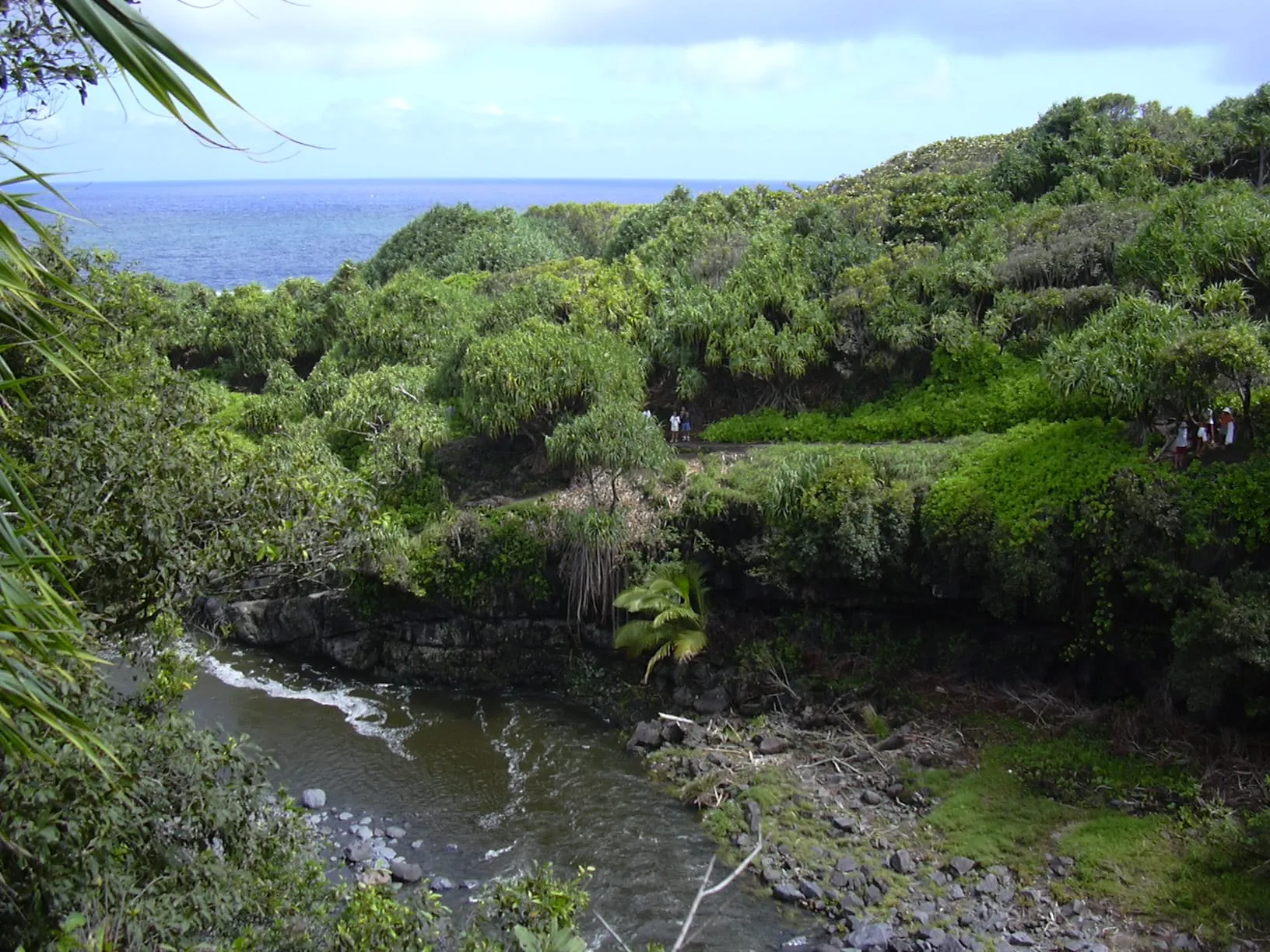
The Pools of ʻOheʻo at Kīpahulu were closed to entry for safety reasons when we checked on 20 November 2026; you can see them from the Kūloa Point Trail. The Park Service words it two ways, which agree: its Kīpahulu page (last updated 16 March 2023) says the pools “are not accessible for entry due to a number of safety concerns”, and its conditions page (last updated 11 February 2026) that they “are not accessible for swimming”. Its campground page goes further: “Entry into the stream at any point in the park is prohibited.” Its hiking page names two of the hazards, flash floods and rock slides. Plan to look at the pools, not to swim in them. The photograph below shows ʻOheʻo Gulch’s stream from above, with walkers on a path over it and the ocean beyond.
Kīpahulu has two trails:
- Kūloa Point Trail: from the Kīpahulu Visitor Center, past a Hawaiian cultural demonstration area, to Kūloa Point at the mouth of ʻOheʻo Gulch, with ocean views and archaeological sites. Half a mile in all, with 80 feet of climb, and the walk for seeing the pools.
- Pīpīwai Trail: 4 miles round trip with 800 feet of climb, which the Park Service calls moderately strenuous. Makahiku Falls comes into view half a mile in, the bamboo forest about a mile in, on boardwalks and footbridges, and the trail ends at the viewing area for the 400-foot Waimoku Falls, 2 miles from the start. Leaving the trail is dangerous and illegal; check for posted trail closures before you set out.
Camping
Staying overnight in the park is allowed only in a designated camping area, and nobody may sleep in a vehicle outside one. Every campsite is reserved ahead, through Recreation.gov, the federal reservation system. The park allows three nights in any 30 days across all its sites, and each Hosmer Grove and Kīpahulu site takes at most six people and two tents.
- Hosmer Grove, in the summit district just past the entrance gate at nearly 7,000 feet: six sites at $20 a night, reserved online only (its page last updated 3 September 2025). A Hosmer Grove reservation also carries a sunrise reservation for the morning after. On 20 November 2026 the Park Service’s alert (last changed 22 October 2026) said the water at Hosmer Grove was shut off by a waterline break, with water around the clock at the Headquarters Visitor Center a mile up the road, and gave no estimate for the repair. Bring your own.
- Kīpahulu Campground, about an eighth of a mile south of the Kīpahulu Visitor Center, above the ocean cliffs: $20 a night, on a rolling 30-day window, with vault toilets, no showers and no water at the campground (there is a water station at the visitor center). On 9 November 2026 the Park Service posted that the campground was open and its road would reopen on Tuesday 10 November, and asked campers to drive the rough road slowly; they may also leave the car in the overflow lot and walk in to their site.
- In the crater: the wilderness tent sites at Hōlua and Palikū, reached only by trail, and the historic Hōlua, Kapalaoa and Palikū cabins, all by reservation only.
Before you go
On 20 November 2026 none of the Park Service’s alerts for Haleakalā closed the summit road, either district or a trail. The Park Service posts a closure as an alert on the park’s conditions page: read it on the morning you go, and expect the summit’s weather to be what the Park Service calls “unpredictable and ever-changing”.
For the summit, our sunrise tours page compares the summit tours for sunrise and sunset, and our bike tours page the rides down the mountain. Getting around the island by car, and the other reservations a driver books ahead, are on our getting around Maui page. For anything else on the island, Viator’s whole Maui listing is at the end of this page.