

For the fewest people and the lowest hotel rates, come in September, October or May; for whales, come in winter. In 2025 those three were Maui’s quietest months, and in September and October hotels across Maui County averaged $424 and $434 a night, against $689 in December. The trade-off is the weather: September and October fall in hurricane season, and May falls outside it. Winter, December to March, brings the whales, the rainy season, the north shore’s biggest surf and the year’s biggest crowds.
Where you stay matters as much as when you come. NOAA’s averages put about 16 inches of rain a year at Kahului Airport and 11 at Kīhei, against about 72 at Hāna, on the windward east side, which is wetter in its driest month than Kahului is in its wettest.
When to come, for what
- The fewest people and the lowest rates: September and October, then May (crowds and hotel rates, below).
- Whales: winter. The months NOAA gives for the season and its peak, and when each whale boat starts and stops, are on our Maui whale season 2026–27 page; the boats themselves are compared on Maui whale watching tours.
- The driest weather: June to September at Kahului and Kīhei. At Hāna no month is dry.
- Calm water: summer, May through October, when the state expects calmer water on all beaches, though the south shore takes its big swells then.
- Big surf to watch: the north shore, November through April.
- The warmest sea: August to October, about 80°F at Kahului Harbor.
- Haleakalā: any month, with winter clothes. A sunrise needs a reservation on every day of the year.
Maui’s weather by month
These are NOAA’s 1991–2020 normals, thirty-year averages, for Kahului Airport, on the low isthmus between West Maui and Haleakalā, with NOAA’s monthly average for the sea at Kahului Harbor. “Days with rain” counts the average days with a tenth of an inch or more.
| Month | High / low °F | Rain, in | Days with rain | Sea °F |
|---|---|---|---|---|
| Jan | 82.2 / 63.6 | 2.42 | 4.0 | 76.1 |
| Feb | 82.2 / 63.8 | 2.00 | 3.8 | 75.4 |
| Mar | 82.9 / 65.1 | 2.64 | 4.5 | 75.7 |
| Apr | 84.5 / 66.6 | 1.32 | 2.5 | 76.4 |
| May | 86.5 / 67.7 | 0.71 | 1.7 | 77.8 |
| Jun | 88.3 / 70.3 | 0.17 | 0.4 | 78.8 |
| Jul | 89.2 / 71.8 | 0.53 | 1.5 | 79.6 |
| Aug | 89.9 / 72.3 | 0.53 | 1.3 | 80.3 |
| Sep | 90.0 / 71.2 | 0.45 | 1.0 | 80.7 |
| Oct | 88.7 / 70.1 | 0.83 | 1.6 | 80.0 |
| Nov | 85.8 / 68.4 | 1.81 | 3.0 | 78.3 |
| Dec | 83.3 / 65.9 | 2.80 | 4.2 | 76.6 |
At sea level Maui is warm in every month. The average high at Kahului runs from 82.2°F in January and February to 90.0°F in September, and the nights from 63.6°F in January to 72.3°F in August. Kahului’s winter days run warmer than the Weather Service’s statewide picture, which puts days usually in the upper 70s, and its winter nights, 63.6°F to 65.9°F from December to February, a little cooler than the mid to upper 60s it gives for low elevations; after a cold front, it says, nights can dip into the 50s. In summer the trade winds blow about 90% of the time, and the drier leeward sides are the hottest. The sea is at its coolest in February, 75.4°F, and its warmest in September, 80.7°F.
Rain depends on the side of the island
Maui’s trade winds blow from the northeast, and the Weather Service says their showers fall mostly on the windward, or east, sides of the islands and near the mountains. NOAA’s averages, in inches:
| Month | Kahului Airport | Kīhei | Hāna Airport (about) | Haleakalā ranger station |
|---|---|---|---|---|
| Jan | 2.42 | 2.31 | 5.6 | 5.14 |
| Feb | 2.00 | 1.17 | 5.5 | 4.08 |
| Mar | 2.64 | 1.92 | 8.5 | 5.70 |
| Apr | 1.32 | 0.39 | 5.0 | 2.75 |
| May | 0.71 | 0.57 | 5.4 | 2.44 |
| Jun | 0.17 | 0.02 | 4.5 | 1.62 |
| Jul | 0.53 | 0.19 | 5.5 | 2.70 |
| Aug | 0.53 | 0.24 | 6.0 | 2.17 |
| Sep | 0.45 | 0.13 | 6.1 | 2.53 |
| Oct | 0.83 | 0.74 | 6.9 | 3.25 |
| Nov | 1.81 | 1.05 | 6.7 | 4.59 |
| Dec | 2.80 | 2.09 | 6.6 | 5.28 |
| The year, the months added | 16.2 | 10.8 | about 72 | 42.3 |
NOAA flags Hāna’s rain figures as estimates, made with the help of nearby stations, so we give them to one decimal. Even so the gap is clear: Hāna takes more than four times Kahului’s rain, and averages over 4 inches in every month, so the Road to Hāna is a wet drive in any season. Kīhei, on the south side, is the driest of the four, with 0.02 inch in an average June. The ranger station near Haleakalā’s park headquarters, about 6,960 feet up, gets about 42 inches a year, most of it from November to March.
The Weather Service calls winter, December to February, Hawaiʻi’s rainy season, “but that doesn’t mean it rains all the time everywhere”: it is unusual, it says, for any rain to last more than a few hours, “so even on the wetter days, the sun usually shines.” March still counts as part of the rainy season, and by April the weather turns toward the trade winds. At Kahului almost three-quarters of the year’s rain falls from November to March, and even then it comes on three to four and a half days a month.
This winter: a very strong El Niño
On 22 October 2026 the Weather Service’s Honolulu office issued its outlook for the wet season, October 2026 through April 2027. With El Niño “in the very strong category”, it said, “the climate model consensus favors unusually high probabilities for below normal rainfall statewide through early spring 2027.” It added that El Niño winters tend to bring weaker trade winds than usual, that drought could develop in many areas in the second half of the winter if the forecast held, and that flash flooding can still happen within a drought. That followed a dry season, May to September 2026, that ranked as the third wettest in thirty years.
The ocean: the north shore in winter, the south shore in summer
Hawaiʻi’s surf runs on two seasons, and the state’s ocean safety site sets them out shore by shore:
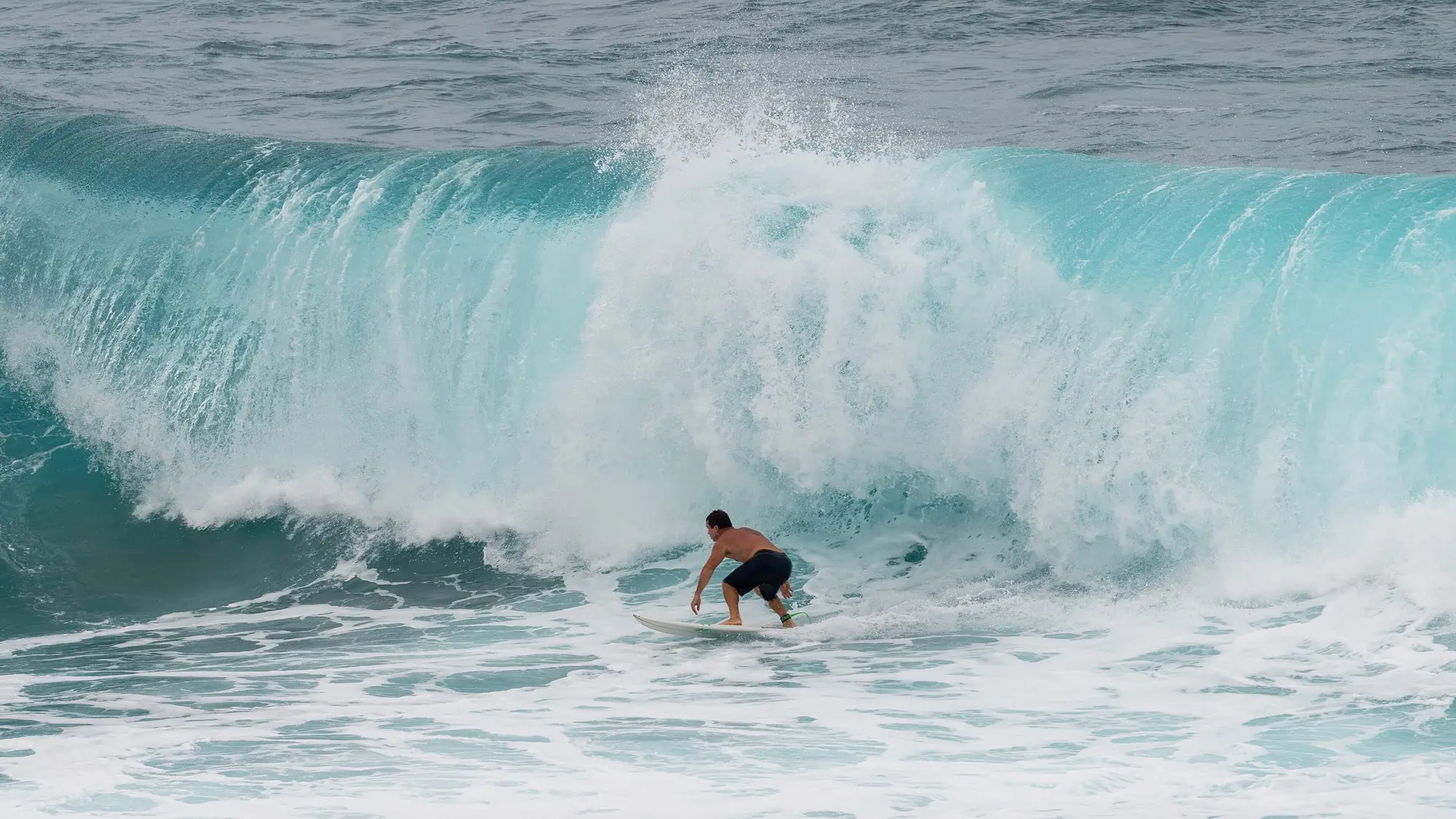
- Winter, November through April. North shores get “consistent huge and dangerous swells”, and the state says inexperienced surfers, and swimmers of any skill level, should stay out of the water at those beaches during high surf. Swells from the north can wrap around onto west shores. South shores run flat to small. The Weather Service counts surf higher than 25 feet many times each winter on the north and west sides of most islands.
- Summer, May through October. The state expects calmer water on all beaches, but south shores take the swells from storms in the southern hemisphere: “Large swells can arrive frequently.” North shores run flat to small. The Weather Service puts the largest south-side surf at about 10 to 15 feet.
- East shores, all year: strong trade winds can whip up large, rough waves.
On Maui that means the north shore, from Kahului east past Pāʻia, is for watching in winter; the south side, Kīhei to Mākena, is the one the state expects to run flat to small in winter and to take its swells in summer; and the west side, Kāʻanapali to Kapalua, can get the northern swells that wrap around. At Mākena the state warns that the shore break “can be very dangerous”, in any season. The boats choose their reefs by the day’s sea, and which shores the surf schools teach on is on Maui surf lessons.
Haleakalā is cold in every month
At the ranger station near the park headquarters, about 6,960 feet up, NOAA’s average highs run from 59.7°F in February and March to 66.1°F in August, and the lows from 42.7°F in February to 49.4°F in August: about 20 to 25 degrees colder than Kahului, month for month. The summit, at 10,023 feet, is about 3,000 feet higher again. The Weather Service puts days above 10,000 feet in winter in the 40s and nights in the 20s, and on Haleakalā in summer highs in the 50s and 60s and lows in the 30s and 40s. Snow falls on Haleakalā about once every 2 to 3 years. The Park Service says the hours around dawn and dusk are regularly wet, windy and below freezing, so a sunrise in August needs the same warm layers as one in January. The park’s conditions are on our Haleakalā National Park page.
The sunrise reservation runs all year, on every day from 1 January to 31 December, and the Park Service says its daily release often sells out within fifteen minutes; the rules are on Haleakalā sunrise reservations. On a Haleakalā sunrise tour you need no reservation of your own, and the guided Haleakalā bike tours ride the mountain in winter as well as summer.
Crowds and hotel rates
The state’s monthly figures for 2025, the last full year: visitors on Maui on an average day, and STR’s average nightly rate and occupancy for hotels across Maui County, which also takes in Lānaʻi and Molokaʻi.
| Month, 2025 | Visitors on an average day | Hotel rate, a night | Hotel rooms filled |
|---|---|---|---|
| Jan | 58,400 | $595 | 62% |
| Feb | 59,100 | $581 | 72% |
| Mar | 60,700 | $577 | 68% |
| Apr | 52,500 | $537 | 63% |
| May | 46,900 | $495 | 59% |
| Jun | 57,200 | $558 | 63% |
| Jul | 57,900 | $558 | 67% |
| Aug | 51,300 | $501 | 62% |
| Sep | 41,700 | $424 | 59% |
| Oct | 47,200 | $434 | 66% |
| Nov | 56,300 | $472 | 66% |
| Dec | 64,900 | $689 | 68% |
December was 2025’s busiest month and its dearest by far, and January to March were busy and dear too. September was the quietest and cheapest, with about two-thirds of December’s visitors; May and October were the next quietest, and October the next cheapest. About 2.53 million visitors came to Maui in the year. The first nine months of 2026, in the state’s preliminary figures, kept the pattern at the cheap end: hotel rates were again lowest in September, $455, and May, $494, and the fewest visitors came in August and September, about 40,900 and 41,100 a day, the most in January and February.
These are hotel figures, one month’s average at a time. The state reports vacation rentals separately, and the taxes on a room are on What a Maui trip costs. Which side of the island to sleep on is on Where to stay on Maui.
Hurricane season
The Central Pacific Hurricane Center’s season runs from 1 June to 30 November, though, it says, “tropical cyclones can and do occur year round.” The Weather Service says the chances begin to really increase from late July into August, and usually fall off quickly by early October, though in an El Niño the threat can last well into November. About 4 to 5 tropical systems occur within 1,500 miles or so of Hawaiʻi in an average year. The 2026 season was a reminder: on 20 November 2026 the state parks division’s notices on the recovery from Hurricanes Nolo and Lowell still listed closed parks on Kauaʻi, and storm damage to a park road on Oʻahu.
For a trip from August to October, book what you can cancel, and keep a day spare for a boat trip the weather calls off.
Season by season
December to February: whales, rain on the windward side, and the crowds
The rainy season, though at Kahului still only about 2 to 3 inches a month, with highs of 82 to 83°F and the sea at its coolest, 75 to 77°F. The north shore’s swells are up, and the south side, Kīhei to Mākena, runs flat to small. Winter is whale season: see Maui whale season 2026–27 for when, and Maui whale watching tours for the boats. In winter most of the sunset sails double as whale watches, and the snorkel trips from the south side sail on the shore the state expects to run flat to small.
December is Maui’s busiest and dearest month: in 2025, 64,900 visitors on an average day and hotels at $689 a night. At Kahului it is the wettest month, 2.80 inches on about four days, with a high of 83.3°F and a low of 65.9°F, and Hāna averages about 6.6 inches. On 22 October the Weather Service’s outlook favored a drier winter than usual, most of all in its second half. January ($595) and February ($581) cost less, but no winter month came cheap in 2025.
March and April: the rainy season’s tail
March still counts as rainy season. It is Hāna’s wettest month, about 8.5 inches. In most years, the Weather Service says, the trade winds can turn strong, 30 mph or more for a few days at a time, especially from March into early April, and large surf can still come, especially in March. March was 2025’s second busiest month, 60,700 visitors a day. By April the weather begins to turn toward the trade winds, Kahului’s rain halves to 1.32 inches, and the crowds and rates ease: 52,500 a day and $537 a night in 2025. Whale season runs on: our whale season page has its end, which NOAA gives two ways.
May: the quiet month before summer
The state’s summer surf season begins in May: calmer water on all beaches, the north shore flat to small, and the south shore’s swell season beginning. Kahului averages 0.71 inch of rain and Kīhei 0.57, the high is 86.5°F, and the sea warms to 77.8°F. Mākena’s big beaches stay open later in the evening, until 7:45 p.m., from May through July. In 2025 May was the second quietest month, 46,900 visitors a day, at $495 a night, and it falls outside hurricane season. It is a good month for the Lānaʻi snorkel boats and the snorkel trips, with the summer’s calm starting.
June to August: the driest months, and busy
The trade winds blow about 90% of the time, and Kahului and Kīhei are at their driest: 0.17 inch at Kahului in June, on fewer than one day, and 0.02 at Kīhei. Highs climb from 88.3°F to 89.9°F, and the sea from 78.8°F to 80.3°F. The south shore is at the peak of its surf season, and the surf schools decide each day whether the surf suits a lesson (Maui surf lessons). Hurricane season opens on 1 June. June and July were busy in 2025, 57,200 and 57,900 visitors a day at $558 a night, and August quieter, 51,300 at $501.
September and October: the cheapest, in hurricane season
September is Kahului’s hottest month, 90.0°F, and the sea is at its warmest, 80.7°F, with October close behind at 80.0°F. Kahului still averages under an inch of rain in each, while Hāna takes about 6 to 7. These were 2025’s cheapest months, $424 and $434 a night, and September the quietest of all, 41,700 visitors a day. The catch is the season: the hurricane threat usually fades by early October, but the Weather Service counts more flash floods in October than in any other month. Book what you can cancel. Haleakalā is at its mildest from June to October, with highs of 64 to 66°F at the ranger station: a good time for a sunrise tour or a bike ride down.
November: the turn of the year
The rain comes back, 1.81 inches at Kahului and about 6.7 at Hāna, and by November, the Weather Service says, larger surf is reaching the north shores. Hurricane season ends on 30 November. In 2025 November was mid-priced, $472 a night, with 56,300 visitors a day. Whale season gets going: the dates, and when each boat starts, are on our whale season page.
On a wet day
When the clouds sit on the windward side, Kahului and Kīhei are drier on average, as the tables above show. Some of Maui’s zipline courses run rain or shine (which ones, on Maui ziplines); there are farm tours Upcountry; and a luau fills the evening, each with its weather terms on its page.
Hours that change with the season
- Mākena State Park: the Division of State Parks opens Oneloa (Big Beach) and Oneuli (Black Sand Beach) daily from 5:00 a.m. to 7:00 p.m. HST, and from 5:00 a.m. to 7:45 p.m. in the summer months of May, June and July. Nonresidents pay to enter and to park: the figures are on Wailea and Mākena beaches.
- Haleakalā’s sunrise: a reservation every day of the year, as above.
- The whale boats: each sells its own season, shorter than the whales’; the dates are on our whale season page.
So when should you go?
If the budget leads, come in September or October, book what you can cancel, and expect hot, dry days on the leeward side and the sea at its warmest. If you would rather stay outside hurricane season, come in May: quieter than October in 2025, drier than winter, with Mākena open into the evening. If the whales lead, come in winter and pay winter’s rates, with December the dearest month. In any month, pick the dry side for beach days, and pack something warm for Haleakalā.


