
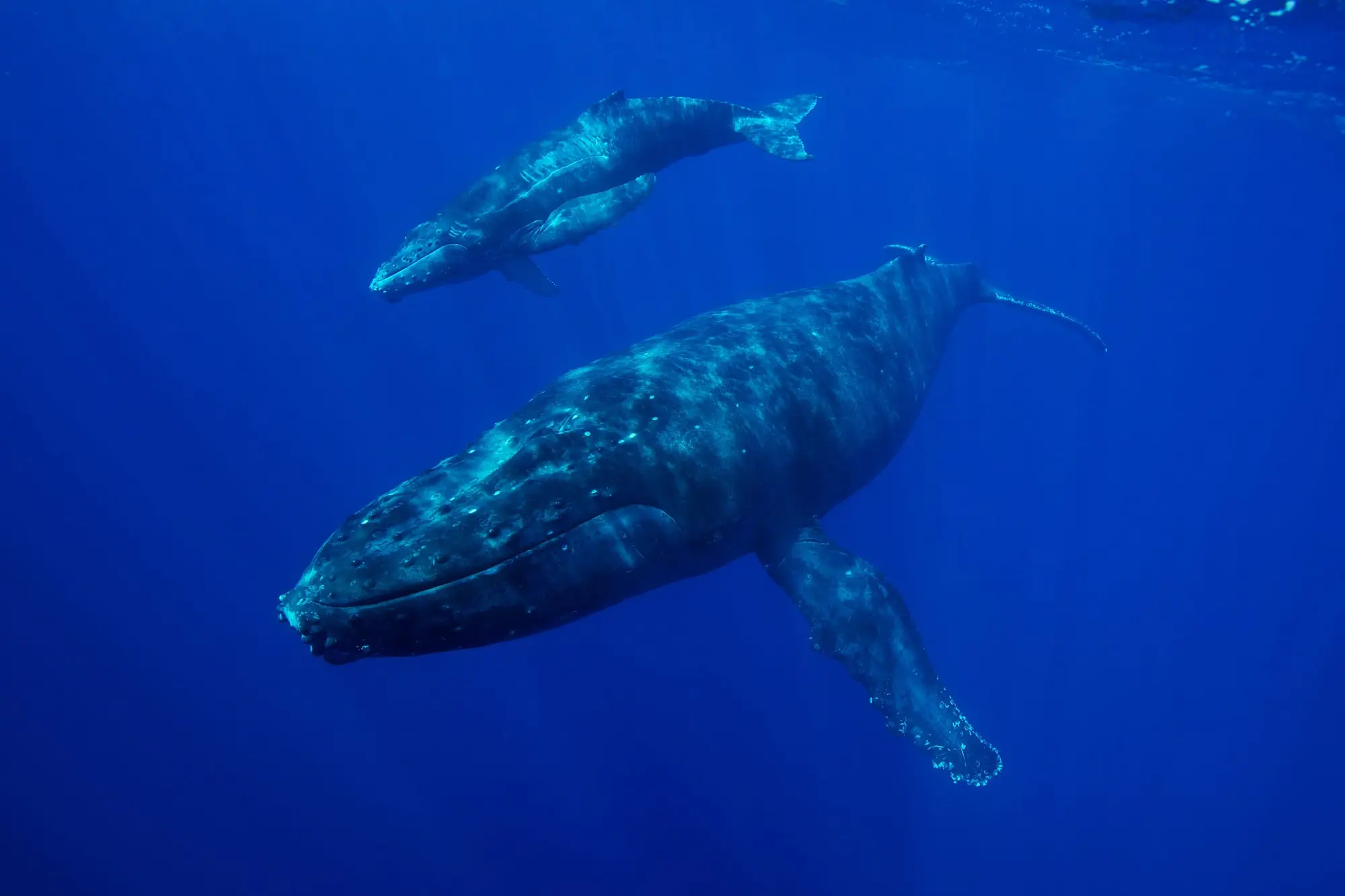

Maui’s humpback whales come in winter, and the months to plan around are January through March. NOAA’s Hawaiian Islands Humpback Whale National Marine Sanctuary gives the season as November through April on its home page and as generally November through May in its boating guidelines, which put the usual peak from January through March. The boats keep a shorter season than the whales: when we read their calendars on 20 November 2026, the ten whale trips we compare had first dates on sale from 20 November to mid-December, and last whale-season dates from 31 March to 30 April 2027.
Three Saturdays in the peak are Maui’s whale count, Pacific Whale Foundation’s Great Whale Count: 30 January, 27 February and 27 March 2027, from 8 a.m. to noon HST at eleven shore sites. And on a boat, on a board or in the water, the law is the same for everyone: no closer than 100 yards to a humpback.
When the whales are here
Every winter thousands of humpback whales, koholā in Hawaiian, come to Hawaiʻi’s warm, shallow waters to mate, give birth and raise their young. NOAA’s sanctuary gives their season two ways:
- Its home page: “From November through April, visitors to the sanctuary can see whales from shore and at sea.”
- Its boating guidelines: the season “generally runs from November through May, although whales may be encountered in limited numbers during other months. The usual peak in humpback abundance occurs from January through March.”
The state’s Division of Boating and Ocean Recreation, on its boating with whales page (last updated 23 July 2025), puts the number at up to 12,000 koholā coming to Hawaiʻi between November and April to breed, calve and nurse their young.
So April is in season on both of NOAA’s pages and May on its boating guidelines alone, and January through March is the peak, the months to build a whale trip around. Late November, early December and April have whales too, but outside the peak there are fewer of them, and at either end of the season fewer boats go out to look.
The 2026–27 season, boat by boat
The boats open their whale seasons one at a time and close them the same way. These are the ten whale trips we compare on Maui whale watching tours, with the first and last dates each had on sale when we read their calendars on 20 November 2026. Where each one leaves from, what it costs and what its guarantee is worth are on that page.
| Trip | First date on sale | Last |
|---|---|---|
| Pacific Whale Foundation | 20 November | 15 April |
| Teralani | 21 November | 15 April |
| Quicksilver | 25 November | 30 April |
| Makai Adventures | 27 November | 25 April |
| Hawaii Ocean Rafting | 1 December for the whale rafts; a whale and dolphin search from 20 to 30 November | 17 April |
| Ultimate Whale Watch | 1 December | April, then again from July 2027 |
| Redline Rafting | 13 December | 31 March |
| Dive Maui | 14 December for the 2-hour trips; 20 December for the 1.5-hour trip | 4 April for the 1.5-hour and sunset trips; the 2-hour trip sells on through to November 2027 |
| Sea Maui | 15 December | 31 March |
| Maui Reef Adventures | 15 December | 15 April |
Month by month, that makes the season:
- Late November. Pacific Whale Foundation (from 20 November), Teralani (21 November), Quicksilver (25 November) and Makai (27 November) are out, with Hawaii Ocean Rafting’s two-hour search for whales and dolphins from 20 to 30 November, which guarantees neither.
- December. Hawaii Ocean Rafting’s whale rafts and Ultimate start on 1 December, Redline on 13 December, Dive Maui on 14 December (its 1.5-hour trip on 20 December), and Sea Maui and Maui Reef Adventures on 15 December. From mid-December all ten are sailing.
- January through March. The peak, with every boat out and the three count Saturdays. Redline’s and Sea Maui’s last dates on sale are 31 March.
- April. Dive Maui’s 1.5-hour and sunset trips end on 4 April; Pacific Whale Foundation, Teralani and Maui Reef Adventures on 15 April; Hawaii Ocean Rafting’s whale rafts on 17 April; Makai on 25 April; and Quicksilver, the last, on 30 April. Ultimate sells whale trips into April.
- May and after. From May, Hawaii Ocean Rafting’s calendar held only its dolphin trips, while Dive Maui’s two-hour trip and Ultimate (from July 2027) sold dates on through to November 2027. Outside November to May, NOAA’s boating guidelines expect whales only in limited numbers, and both of those trips guarantee whales only from December to April.
The 2027 whale counts
Maui’s whale count is Pacific Whale Foundation’s Great Whale Count, and its counts for 2027 are on three Saturdays: 30 January, 27 February and 27 March, each from 8 a.m. to noon HST. Volunteers spend the morning on the shore counting the whales they see, and the foundation’s count dates back to 1995.
The sanctuary runs its own Sanctuary Ocean Count on the other islands, on the same Saturdays: oceancount.org lists its 2027 counts for 30 January, 27 February and 27 March, and the sanctuary’s count page says the Great Whale Count “takes place on the same dates on Maui, led by the Pacific Whale Foundation”. The two have been held on the same days in January, February and March since 2019, so the whales around all the main islands are counted on the same mornings. The Ocean Count began in 1996, and 2026 was its 30th year. In the 2025 counts, 1,353 volunteers watched from 44 sites on Hawaiʻi Island, Maui, Molokaʻi, Lānaʻi, Oʻahu and Kauaʻi and tallied 4,782 koholā over the three days, a figure the sanctuary notes may count the same whale more than once.
What a counter does. Arrive by 8 a.m. and stay until noon, with breaks through the morning. Each counter scans an assigned stretch of ocean and reports what the whales are doing to the site leader. Bring binoculars if you have them (none are provided, and they are not required), plenty of water, snacks, sun protection and a chair.
Signing up. Every counter registers as a volunteer with Pacific Whale Foundation, family and friends included, and each site takes a limited number. A friend who comes along to a full site may stay, but not as an official counter. If bad weather covers the whole island, the foundation and the sanctuary decide the plan and email registered volunteers; at a single site, the site leader decides, and no volunteer has to attend a count that feels unsafe.
Maui’s eleven count sites are The Ritz-Carlton Maui, Kapalua; Pohaku Park; Hoʻokipa; Marriott’s Maui Ocean Club Lahaina & Napili Towers; Launiupoko Beach Park; Māʻalaea Harbor; McGregor Point and Lighthouse; the Hawaiian Islands Humpback Whale National Marine Sanctuary Visitor Center; Kihei Surfside Resort; Polo Beach; and Puʻu Ōlaʻi Beach. Each volunteer hears about their own site’s amenities once accepted; the sites vary widely, and parking and restrooms can change without notice.
Watching from shore
“From November through April, visitors to the sanctuary can see whales from shore and at sea,” NOAA’s sanctuary says, and no boat is needed for that. The count’s sites are a ready list of places to look from: seven are beaches, parks, a harbor and a point (Pohaku Park, Hoʻokipa, Launiupoko Beach Park, Māʻalaea Harbor, McGregor Point, Polo Beach and Puʻu Ōlaʻi), three are resorts, and one is the sanctuary’s own visitor center.
The sanctuary’s visitor center in Kīhei, at 726 South Kīhei Road, is on the beach at the foot of Haleakalā, looking across the sanctuary’s waters to Kahoʻolawe, Lānaʻi and West Maui. NOAA calls it an ideal spot to learn about the marine environment “and even see humpback whales breaching”. It has exhibits and weekly programs, and Kōʻieʻie, one of the last intact traditional fishponds on the South Maui coast, fronts the property. It opens Monday to Friday, 9:30 a.m. to 2:30 p.m. HST, and closes on federal holidays.
What to look for. NOAA tells boaters to watch for “blows” (the whale’s exhalation), the backs of whales and their tails (flukes), and from shore the same signs are what you scan for. For a closer look, its advice is binoculars, a spotting scope or a camera with a zoom lens.
The 100-yard rule
The law keeps everyone at least 100 yards from a humpback whale. In the sanctuary’s words on its regulations page, the rule “prohibits approaching humpback whales by any means (e.g., an individual in the water, standup paddleboards, kayaks, canoes, vessels, and drones) within 100 yards (90 m) when on or in the water, and 1,000 feet (300 m) when operating an aircraft.” It applies to everyone on the ocean, all year, in the sanctuary and anywhere in Hawaiian waters out to 200 nautical miles.
What it means for you:
- On a whale boat, the captain does the waiting. A boat that finds itself within 100 yards stops, engines running and in neutral, until the whale moves away. Nor may it cut across a traveling whale’s path so that the whale comes to it: the state calls that leapfrogging, and it is not allowed. The closest looks come when a whale surfaces near a boat that has stopped, and a low raft puts you at the whale’s eye level, not nearer to it.
- In the water, or on a kayak, canoe or paddleboard, the same 100 yards hold. If a whale comes toward you, NOAA’s advice is to stay calm and back away slowly, make no sudden moves and keep out of its path. On a kayak or paddleboard, make some noise now and then so wildlife knows you are there.
- With a drone, 100 yards as well; in a plane or helicopter, 1,000 feet.
- At the helm of your own boat, NOAA and the state recommend speeds: a top speed of 15 knots, or safe planing speed, in whale season, and no more than six knots within 400 yards of a whale. The sanctuary also offers a free online course, Spout Spotter, in safe and respectful whale watching for anyone heading out on the water.
If you see a whale tangled in line or hurt, from a boat or from shore, call NOAA’s Marine Mammal Hotline, 1-888-256-9840, or, if you cannot call, hail the Coast Guard on VHF channel 16, and never try to free it yourself. A boat, swimmer or drone crowding a whale is reported to the NOAA Fisheries Enforcement Hotline, 1-800-853-1964.
Getting out on the water
The ten whale trips, with where each leaves from, raft or big boat, what each costs and what its guarantee is worth, are compared on Maui whale watching tours. The rest of a winter trip is on the best time to visit Maui. If no whale trip there fits your days, the Maui listing at the end of this page is everything bookable on the island.


