
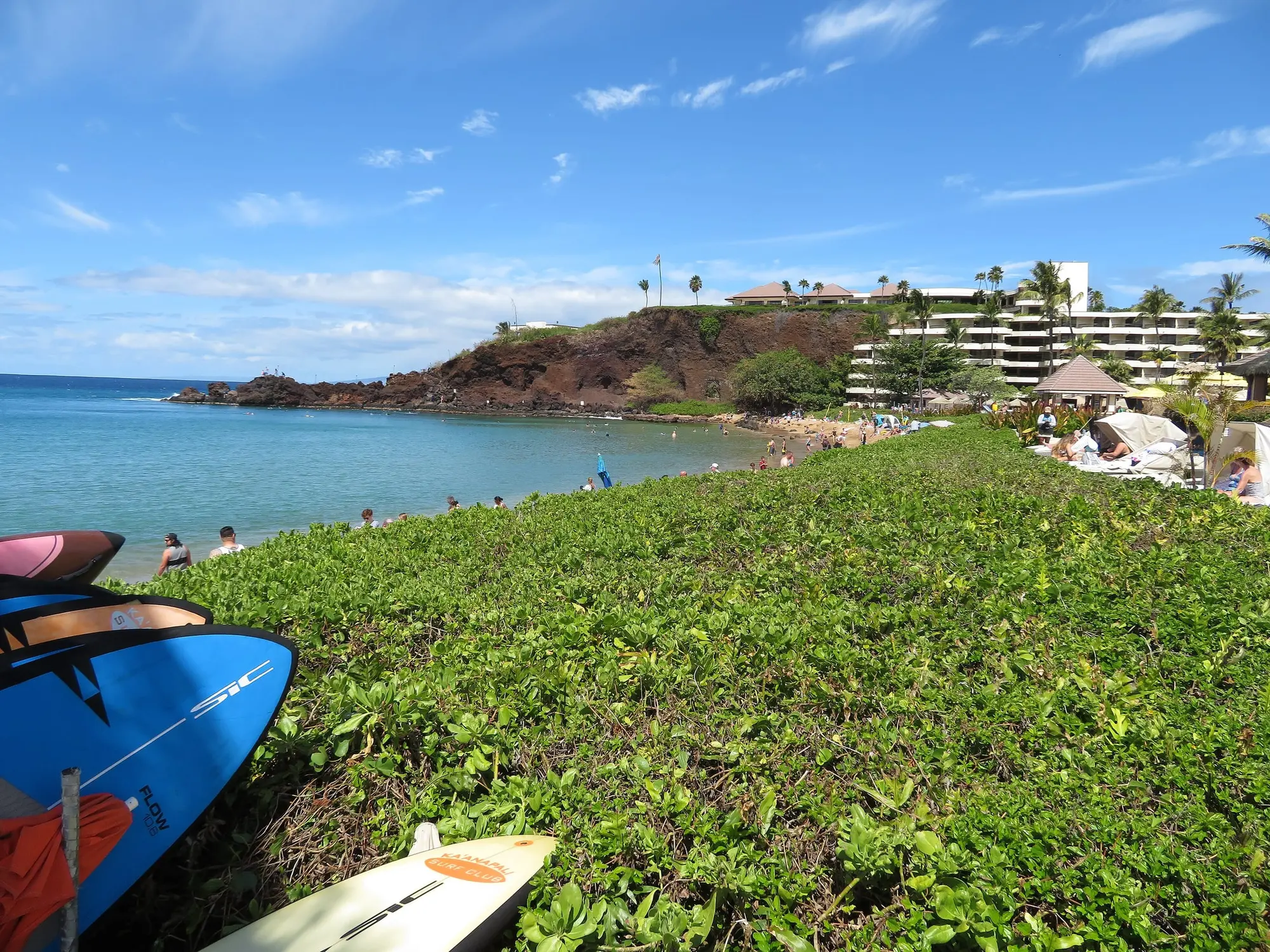

Canoe Beach to Black Rock
Kāʻanapali Beach runs north from Hanakaʻōʻō Beach Park, also called Canoe Beach, to Puʻu Kekaʻa, the volcanic point known as Black Rock: nearly 7,500 feet of sand by the state’s measure, with Hanakaʻōʻō Point in the middle. Past the rock, North Kāʻanapali Beach carries on to Kahekili Beach Park, and the Kāʻanapali Beach Resort Association counts the whole shore as three miles of white sand. The Kāʻanapali Beachwalk, a concrete path behind the sand, runs the length of the beach past the hotels and the Whalers Village shopping center.
The two halves swim differently. From Hanakaʻōʻō Point north to the rock the seafloor is mostly sand, so that is where swimmers gather, wading in and out barefoot. South of the point a shallow reef shelf lines the shore, broken by a sand channel off the Hyatt Regency Maui, the remnant of an old stream. The reef off the point itself is the beach’s most consistent surf break, at its best in summer. In 2018 three outrigger canoe clubs were based at Canoe Beach, at the south end.
The sand moves with the seasons. Summer swells come from the south and push sand north toward the rock, widening the beach at that end; winter surf from the north reverses it, stripping sand from the Black Rock end and piling it up at the point. Molokaʻi blocks the northwest swells, but swells from farther north still reach this beach, with big shorebreak, rip currents and strong currents along the shore. Behind the seasons is a longer loss: the state’s Office of Conservation and Coastal Lands says four decades of chronic and seasonal erosion have narrowed the beach south of the point, cut into access and damaged the beachwalk.
Lifeguards: one tower, at the south end
The only lifeguard tower on Kāʻanapali Beach is the County’s, at Hanakaʻōʻō Beach Park, the one the County’s own tower list names on the beach. On the state’s list of lifeguarded beaches, last updated 15 June 2026, its hours are daily, 8am-4:45pm HST. The County’s Ocean Safety Bureau gives its lifeguards longer days: its Ocean Safety page, when we read it on 20 November 2026, gave their hours as 7:30am to 6:15pm HST from 16 September to 15 March and 8:00am to 6:45pm from 16 March to 15 September, the schedule the bureau announced on 17 April 2025, when it said their hours can be extended to sunset when high surf or other dangerous conditions call for it. The state’s list carries the later date (the County’s site search dates its page 7 May 2026); both have a lifeguard in the tower from 8am to 4:45pm, so swim within those hours. The state’s 2022 public-safety sheet for the beach puts the rest plainly: “There are no lifeguards beyond Hanakaʻōʻō Beach Park.” The stretch from the point to Black Rock, where most people swim, is unguarded, and so is North Kāʻanapali as far as Kahekili. When no lifeguard is in a tower, the state’s advice is to call 911.
The same sheet lists what catches swimmers here:
- currents along the shore, driven by the tide and the waves, that turn seaward as rip currents;
- sandbars that form and move along the shoreline and injure people diving into what they take for deep water;
- steep drop-offs that can take your footing;
- long calm spells followed by short sets of large waves;
- numerous shark sightings near the beach over the years, and man-of-war and box jellyfish now and then.
After a shark incident, the state’s conservation officers post warning signs along the shore. When a snorkeler was bitten off Airport Beach, north of Black Rock, in January 2021, the signs went up from Black Rock to Honokōwai Beach Park, and DLNR explained that such signs always stay until noon the next day, once officers and lifeguards have checked the water. Stay out while they are up.
Black Rock: Puʻu Kekaʻa and its snorkel
Puʻu Kekaʻa is a cinder-and-spatter cone that divides Kāʻanapali Beach from North Kāʻanapali Beach, with the Sheraton Maui Resort & Spa at the rock and the Royal Lahaina on its north side. In Hawaiian tradition it is a leina, a leaping place of the spirits, and the historic marker on the beachwalk calls it a sacred spot, “the place where a soul leaps into eternity.” It deserves the respect that name asks for.
The water around the rock is one of the most popular snorkel spots on Maui: clear, as deep as about 25 feet, with fish, turtles and crustaceans. You swim to it from the sand on its south side, in front of the Sheraton, where the bottom is sand rather than reef. Keep at least 10 feet from a turtle, in the water and on the sand, as NOAA asks. A 2018 survey of the beach’s uses, in the environmental impact statement for the beach’s restoration, found a beach concession renting snorkel gear and giving first lessons at nearly every hotel on it.
Pick the day. The rock sits at the end of the beach that northerly swells hit hardest, mostly from November to April, and no lifeguard watches it. A day when the beach’s boats cannot land is not a day to snorkel the rock.
The low cliff on the rock’s south side, about 30 feet above the water, is where people jump: they swim over from the beach and climb up. At the time of that 2018 survey, the Sheraton held a ceremony on the rock every evening that ended with a single diver’s leap from the cliff.
For reefs beyond the rock, the snorkel boats on this beach sail to other spots along the West Maui coast; we compare them on our snorkel tours page.
The boats that leave from the sand
The boats here moor off Hanakaʻōʻō Point and come to the beach for their guests. Catamarans land right on the sand, in boat lanes the state sets, and the monohulls ferry their guests out by small boat, so you check in on the beachwalk and board from the beach:
- Teralani checks you in at the Aqualani beach services kiosk on the Kāʻanapali Beachwalk, on the ocean side of the Outrigger Kāʻanapali Beach Resort. Its winter whale watch checks in at the same kiosk.
- Sea Maui at its kiosk between Leilani’s and Hula Grill, on the beachwalk at Whalers Village.
- Gemini on the lawn between Leilani’s and Ulu Kitchen, at Whalers Village.
- The Magic Merman on the beach in front of Leilani’s, at Whalers Village.
Each asks you to be there 30 minutes before the boat leaves. Since they load on the sand, the surf decides: in that 2018 survey of the beach’s uses, many of its boats had their own rules for calling off a trip, such as a high surf warning for the coast, which rules out landing on the beach, or trade winds over 28 knots.
Which sail to take, cocktails or dinner, and what each costs and includes are on our sunset and dinner cruises page. The morning snorkel boats are on snorkel tours, and the winter whale trips on whale watching.
The luaus on the beach
Four luaus are staged at the resorts along this shore:
- the Maui Nui Luau, by Tihati Productions, at the Sheraton Maui Resort & Spa, at Black Rock;
- Myths of Maui at the Royal Lahaina, 2780 Kekaa Drive, on the rock’s north side;
- Wailele at the Westin Maui Resort & Spa;
- Huakaʻi, on the lawn at the Hilton Vacation Club Kaʻanapali Beach, 104 Kaanapali Shores Place.
From a hotel on the beach, each is a walk or a short drive. Their nights, prices, seats and dinners are compared on our luau page.
Whales in winter
Humpback whales come to Hawaiʻi’s warm, shallow water each winter, and NOAA’s humpback whale sanctuary says that from November through April visitors can see whales from shore and at sea. For a closer look, Teralani’s whale watch checks in at the Aqualani kiosk on this beach; the trips that board here, and the dates each sails, are on our whale watching page, and the season itself on Maui’s whale season, 2026–27.
Parking and public access
The beach is public. In 2020 the state listed the ways onto it as Hanakaʻōʻō Beach Park and six public rights-of-way running down to the shore between the resorts, with access along the beach on the beachwalk and the sand.
The County of Maui’s shoreline access survey, from its site visits in June 2018, gives the parking at the accesses from Kahekili to Canoe Beach. North to south:
| Access | Stalls the County counted (June 2018) | Restroom, shower | The County’s hours label |
|---|---|---|---|
| Kahekili Beach Park, North Kāʻanapali, north of Black Rock | 100 | Yes, yes | Restricted Hours |
| The Sheraton, by Black Rock | 19 | No | Open All Hours |
| Whalers Village | 50 | No | Open All Hours |
| The Hyatt and Marriott access | 11 | No | Open All Hours |
| The Hyatt access | 10, and 20 more at Lahaina Villas, by the County’s note | No | Open All Hours |
| Hanakaʻōʻō Beach Park (Canoe Beach), a County park | 25 | Yes, yes | Restricted Hours |
Two more public accesses on the County’s list, the ones it calls Alii/Maui Westin and Kaanapali Beach North, have no parking. The survey counts stalls; it has no field for a charge, and its labels give no opening times. The resort association’s own guide to the beach lists “Parking (fee)” among its amenities, without saying which lots or how much. For the boats: Sea Maui validates four free hours in the Whalers Village parking structure for its passengers, and Gemini gives its passengers a four-hour validation there.
The County marked the four resort accesses and Kahekili wheelchair accessible in 2018, three of the resort accesses only while erosion control holds, and Hanakaʻōʻō Beach Park not accessible.
Getting there
Kāʻanapali is on Maui’s west coast. From Kahului Airport it is 26.7 miles to Whalers Village, about 49 minutes with no traffic; from Kīhei it is about 55 minutes and from Wailea about 1 hour 5 minutes. Up the coast, Nāpili is about 12 minutes away and Kapalua about 15. The island’s roads are on getting around Maui, and Lahaina, the next town south, has its own page, Lahaina for visitors now. The hotels and condos on this shore are on where to stay on Maui, and the south coast’s beaches on Wailea and Mākena.
When to go
Summer, May to October, is when the state’s ocean safety office expects calmer water on all beaches, and when the sand builds up at the Black Rock end: the best months for a swim and the snorkel. From November to April, swells from the north can wrap around to the west shore and bring high surf, and the whales are in. In any month, the lifeguard is at the south end only.

